Thursday, July 15, 2021

Storyboard Artist Michael Ruocco's Own Words on Bugs Bunny's "Mummy Dummy"

 Reposted and assembled from Michael Ruocco's thread at https://twitter.com/AGuyWhoDraws/status/1415132169706491905 with additional video comparisons of his storyboards with the finished animation. Big Spoiler Warning!

I've been waiting over 2 years to talk about this, and now I finally can. Here's a behind-the-scenes thread about the making of my first "Looney Tunes Cartoons" short: "Mummy Dummy".

(Mummy Dummy was our original outline title, which we thankfully kept.):


Being so early on, we were all sort of testing the waters in regards to what we could do, which in a way also meant "what could we get away with?". How close in terms of the original LT short's content/violence could we do? Could/should we go even further? etc. Personally, it was both super liberating and very daunting, after coming off of 3yrs on "Wabbit/New Looney Tunes", where we could barely get away with anything even remotely violent without S&P stepping in and cutting us off at the ankles. So I asked "could I...?" an awful lot.

Despite this, my experiences on Wabbit/NLT were a huge benefit in regards to how I would tackle my boards from an economic standpoint without sacrificing the humor or flow. Each production's budgets and standards/practices aside, the staging/ rules were still relatively the same. I kept my shots mostly wide in classic vaudeville staging, with occasional cinematic cuts and angles to mix it up, all leading up to the crazy Hitchcock-like horror scene (which I'll get to later):


Again, since I was just off of Wabbit/NewLooneyTunes a few months earlier, I was still shaking the old show's style off and gradually adapting to our Soper/Clampett approach. I was still drawing Bugs too thin, eyes too close together, etc., and drawing a bit too graphically:


It was fun being able to draw Bugs with those gnarled Rod Scribner teeth and with actual cheeks that had volume. Still was figuring out how far I could push the poses and shapes, and I didn't really find my stride until a few shorts in:


My first "can we actually show this?" gag. Testing the waters:


Pete (Browngardt) had very specific ideas in mind in regards to what the Mummy should look like and we went back and forth with him, along with Alex Kirwan, David Gemmill and Carey Yost, to find a design we were happy with. I love the sort of a hulking, Alice the Goon look we ended up with:
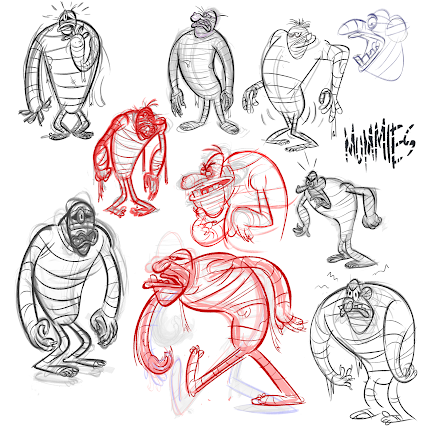


My feeling always is, if it's fun to draw/show them getting hurt, then the design works:


One of the story issues we faced was how oblivious should Bugs be to what's going on around him. Does he honestly think this is a themed resort? How oblivious or self aware do we make him? I took inspiration from the Jekyll/Hyde and Count Bloodcount shorts (and Gossamer too):


Early on I was really pushing my pun-muscles and definitely went overboard. Still, I'm proud of my crypto-currency line which, sad to say, is still relevant years after writing it:


Here we go... here was our next "can/could/should we?" bit. Gemmill and I brainstormed about what one would find in an Egyptian tomb that an unknowing tourist would confuse with a five-star hotel, and we joked about a buffet gag and thought "let's just try it."

It was pitched, it got laughs and tentative approval. Worst case scenario, it gets cut and we pull it back. And surprisingly, it went through as is. My thought was, its this mummy's own organs, and he's already dead, so it's not so bad. And Bugs is blissfully ignorant of it:


Whoever animated the foot stomping scene at Yowza Animation, you absolutely nailed it. And overall, the animators up there did a fantastic job, and found fun ways to pluss the action (i.e. Bugs squeezing the "juice" out of the heart, etc.):


I honestly think this is probably the farthest I've ever gone in turns of "gross" humor, especially on this show. I usually am not the type to do gags like this, and didn't for the rest of the series. But in the context of this cartoon, it was fun and it fit!:


Again, it was fun knowing we could push the expressions as far as we could compared to "Wabbit", and Bugs is a hard character to break.


Another fun scene! Technically, I was still figuring out how to work best in Storyboard Pro, so I tried doing a few scenes loosely with bitmap brushes. It felt nicer, but so many textured lines weighs the software down. I remember playing back these scenes made my work comp chug:


My original camel design was just the camel from Clampett's "Porky in Egypt" short, but I absolutely adore the design Stephen DeStefano did in the final short. Love his shaggy hair.


So now we come to the climax of the cartoon, and we knew we really wanted to play up the sort of formulaic "creeping monster" idea and have the conclusion take a real shocking left turn nobody would expect. Again, Gemmill and I brainstormed a massage gag and we said "why not?"
I remember when I pitched this in the room with the crew and the gasps it got. Same when it played at Annecy in front of a crowd of hundreds of international animators (mostly French). The reactions were amazing. It was worth it for that alone.

I think the combination of DeStefano's special poses, Joshua Moshier's amazing score (was so tickled at his use of "Night on Bald Mountain" when I first heard it), Aaron Spurgeon and the BG team's amazing color choices and Tommy Meehan's editing really sold this sequence.

It was a very cathartic scene to board after not being able to do anything remotely violent with these characters for years, and just seeing how far I could go.  I got to channel a bit of Hitchcock's Psycho and, funnily enough, Watership Down.

I could be one of the few people in the world who gets to say "I got to "kill" Bugs Bunny.":


Yes, I'll admit, the scene IS over-the-top. We didn't need to go this far, and it's partly the reason why this short, made so early in production, took this long to release. But I knew it was all planned for a reason. I knew we needed a REAL subversion of expectation, and I think we did it well. And in the context of this short; the looming threat, the formula, who Bugs is, it WORKS. I had my cake and got to eat it too. I think Clampett would of done it too.


After that scene, it was time to get out of the cartoon as quickly and humorously as possible. The tables have turned, Bugs is now fully in control and the mummy's on the retreat. Gotta get the final laughs in til we iris out.


This short was all a huge experiment for me, and a great learning experience in regards to story structure, brainstorming and just getting a feel for what ultimately would be one of the most rewarding and fun work experiences I've ever had in animation. I got to see how supportive everyone on the team was going to be, how great and empathetic of a leader Peter Browngardt would be, how truly dedicated and skilled the design team was, and how great  David Gemmill's direction & guidance was, and got to build such a rapport with them all. And after this cartoon, we eventually had a full board room full of amazing folks would could bounce looney ideas off of, and it was so exciting waking up and going into that room each day of all those 2+ years.

- Michael Ruocco

Wednesday, July 14, 2021

Character Builders Production Gallery of Space Jam

   A reposting from former Ohio animation studio Character Builders's detailed Space Jam feature on their website from 1997. Link at https://web.archive.org/web/19970128200303/http://www.cbuilders.com/sjgall.htm.


TheSpace JamGallery Herb the Bunny

In order to arrive at the finished product you see on the screen, artists created hundreds of thousands (probably millions, actually--nobody actually counts 'em) of individual drawings and paintings. Most of them were never seen in their initial form. Some were just "stepping-stones"--for example, storyboards or animation drawings that were eventually cleaned up and colored digitally. Some were discarded when the story changed, or to make the movie shorter. Some were just plain terrible and were hidden away by their creators before anybody ever saw them. The images presented here have been annotated with production notes, inside information, and comments from the artists who drew them.


Layout drawing by Jim Kammerud


"Tomorrow is another day..."

"This looks like the beginning of a beautiful friendship..."

"That's all, folks!"

We were pretty excited when it turned out that we were going to be assigned the movie's final scene--it meant we'd get to animate one of the most famous closing lines of all time.

So who was given the honor? Well, through all of the scene's incarnations and revisions, at least five animators touched the scene at one moment or another, along with assistants, inbetweeners, scanners, painters, checkers, scene planners, and many others. Like any production, it got sort of crazy, and even on a scene like this, it's easy to get immersed in the task at hand--in just getting the scene done. Then, later, you look back and say, "Hey! I'm making a movie with Bugs Bunny!"


Storyboards by Dan Root


At one point, the final game was to have a decidedly different tempo and atmosphere than the one that ended up in the film. In this version, the Monstars are darker and far more menacing. These boards depict the Monstars as flashing shadows that hit the court and go berserk, giving the sense that Michael's in real danger.


Animation rough by Dan Root


Null wasn't allowed to grab his crotch in the final animation. It happened pretty fast, so the producers were afraid that people might think that it was a "hidden gag," and there would be an outcry like the one caused by the pantiless Jessica in Roger Rabbit, or the "S-E-X" written in the clouds in The Lion King . In reality, it was just an attempt by Dan to be contemporary and give the characters some "attitude."

Another scene (not one of ours) that didn't get through was one in which Lola Bunny's top rides up and reveals just a little too much--not enough to be obscene, but enough to give adolescents with laserdisc players some amusement. Sorry, Lola fans...


For a while, artists explored the possibility of depicting Swackhammer as a sort of machine-age carnival impresario. This led to a series of conceptual drawings where he appears as a Mr. Hyde-like character complete with stove-pipe hat and opera cape. These drawings are all from very early in the production--long before even Jack Palance (who was later replaced by Danny DeVito) was cast in the role.

Then there was the "Little Lord Fauntleroy" version...

Swackhammer designs by Brian Smith

Design by Brian Smith

The Looney Tunes characters were pretty much designed long before the movie ever entered production (although a lot of time went into the process of deciding which old designs to use), but the Monstars, Nerdlucks, and Swackhammer went through many possible incarnations, from evil corporate mogul (above), to interstellar swinger, to Godfather (below, left and right).

Designs by Dan Root

Designs by Marty Fuller

This design of Swackhammer on his personal flying saucer inspired story discussions in which Swackhammer becomes personally involved in the game. When he sees his team about to lose, he storms onto the court, rips the rim off of the Monstar's goal, and flies off with it, forcing Michael to execute the "ultimate sky," leaping to a truly spectacular height in order to make the dunk.

Concept sketch by Marty Fuller

The Monstars ran the design gamut from being almost straight caricatures of their corresponding NBA players to looking like nothing even human. This Patrick Ewing Monstar has little in common with the final designs used in the movie.

This very early drawing was done in the first days of the production, in a trailer on the Universal lot, with no windows, orange carpet, and '70s rec-room panelling on the walls. Close to twenty artists and a production staff manned the trailer, which was close enough to hear the hydraulics and the screaming tourists when the Jaws shark on the Star Tours ride.


One day while he was designing Nerdlucks, Dan Root was clubbed unconscious and his body taken over by the ghost of Walt Kelly.

This is not one of Dan's favorite drawings. "This is them without individiual personalities, really. They acted more like a group. Except for the one guy, who is the guy who always touches things he shouldn't. Which isn't really much of a character."

Concept sketches by Dan Root

Dan wasn't too fond of this one, either. "This was from when Jerry [Rees, one of the original animation producers] wanted the Nerdlucks to have different personalities. I just think it's really TV-looking."


Concept sketches by Marty Fuller

These appliances in Swackhammer's office were "minion-powered," sort of like a high-tech Flintstones, only more cruel, because the the technology to use, say, electricity obviously exists. Though these designs were never used, it's possible to imagine the Nerdlucks' airship being propelled by thousands of these poor blighters somewhere in the ship's belly.


Storyboards by Dan Root

A big hunk of the Monstars' transformation sequence was cut in order to keep the picture moving briskly along, including this scene: Daffy is picked up by Zilch; we hear an offscreen CRUNCH as the rest of the gang react; and then the Monstars line up to use our hapless hero as a speed bag.

When a sequence like this is cut, it usually happens while the scene is in storyboard form, long before animation starts. It's just too expensive to animate anything you're not sure of, so the boards are drawn and redrawn, timed and retimed, until they're dead on.


Concept drawing by Marty Fuller
Concept drawing by Dan Root

Early Nerdluck designs ranged from Edward G. Robinson-like slugs (top) to amorphous little amphibians.

The little aliens were tough to peg. Their designs changed slightly even after they had been approved and models had been sent out to various merchandising manufacturers. Not enough for your kids to notice, but enough for an exhausted artist who's been cleaning up Nerdlucks for six months to pick up a toy and murmur, "Hm. Neck's too long."


Storyboards by Dan Root

In the movie, Michael's kids are watching a Roadrunner cartoon that is interrupted by Porky, who arrives to inform them that a Cartoon Character Union meeting's been called. A brand-new "mini-cartoon" was boarded before it was replaced by footage from an actual vintage short. This was one cut that nobody was too upset over. The cut saved time that was better used elsewhere in the movie; the original footage was immediately recognizable and made the interruption more startling; and, frankly, nobody ever really felt right about trying to recreate something that had been done so perfectly by Chuck Jones.


Concept drawing by Dan Root

It's very likely that this "Cross-Training Daffy" drawing from Daffy's runway scene was Dan's way of working into the movie a funny drawing he'd done weeks earlier of Daffy in his underwear but didn't really have a place for at the time.

One gag that didn't make it to the screen was a moment in which Bugs and Daffy take advantage of one Monstar's natural stupidity and trick him into letting Bugs and Daffy do his hair and give him a pedicure.

The dialogue that went with it?

"Mon-n-starrs are such in-n-n-teresting people!"

Of course.

Character Builders Frequently Asked Questions on Space Jam

   A reposting from former Ohio animation studio Character Builders's detailed Space Jam feature on their website from 1997. Link at https://web.archive.org/web/19970128200343/http://www.cbuilders.com/sjfaq.htm.


Space Jam Frequently Asked Questions Herb the Bunny

Here they are--the questions we here at Character Builders get asked most often whenever Space Jam comes up in a conversation. It's a short list, though. If you have a question that's not answered here, please send us e-mail and ask it--we'll do our best to supply you with an answer.

Don't they do it all with computers nowadays?

This is the big one. We get asked this question three times for every other question we hear. Die-hard animation fans, skip this question.

Although computers are used in many different ways throughout the animation process, all of the character animation you see in Space Jam was drawn by an artist using a pencil. Every Bugs, every Monstar, every Lola. All drawn by hand, by a live human. There isn't a computer in the world that can do traditional (sometimes known as "two-dimensional") animation--making the real world look like a flat drawing is a level of abstraction that a computer can't achieve yet.

That being said, computers were used all over the place. Cinesite digitally created a three-dimensional gym that 2-D animation was composited into (also using computers, of course). All of the animation was digitized and colored using a computer. We used Amiga computers to do rough tests of our animation. And these are just a few examples.

Computers are essential to animation, just as they are essential to accounting, journalism, and rocket science. But computers don't do animation. Artists do animation. Even "computer" animation requires a talented artist sitting at the monitor figuring out how to make a scene funny, or dramatic, or frightening.

What parts of Space Jam did you work on?

Primarily, three sequences of the movie: Bugs meeting the aliens, the "Union Meeting" where Bugs challenges the aliens to a basketball game, and the Monstars' transformation scene. Character Builders artists, under the supervision of sequence director Jim Kammerud, storyboarded and animated almost all of those sections through finished clean-up. We also boarded and animated other portions of the film, for a total of about ten minutes.

Character Builders contributed to other areas of the film as well, including early conceptual art, character design, and scene planning.

Did you get to meet Michael Jordan?

Most of the thousand-plus of the animation staff of Space Jam didn't. Some of the story artists were on the live-action set with him, as were the animation producers and directors. Sequence director Jim Kammerud met him. "He's not as tall as you'd think," he says. "But his hands are huge, and really... rough."

Did Mel Blanc's son do the voices?

Noel Blanc does not provide voices for any of his father's characters in Space Jam.

Bugs Bunny is voiced by Billy West, the actor who played Ren and Stimpy. Dee Bradley Baker plays Daffy Duck and the Tazmanian Devil. Bill Farmer is the voice of Sylvester, Yosemite Sam and Foghorn Leghorn. Porky, Tweety, and several others are the work of Bob Bergen; and Kath Soucie provides the voice of Lola Bunny.

Is my favorite character, Speedy Gonzales [or Sylvester, Jr. or Hippety Hopper or whoever] in it?

Well... you might be surprised who you'll find if you look close enough. The artists had fun sticking in lots of very minor characters from the old cartoons. There wasn't enough screen time, though, to use characters such as the Three Bears or Eggbert as anything more than extras.

How many drawings does it take to make a movie like this?

Nobody really keeps track. If you count all of the storyboard drawings, design sketches, layouts, animation roughs and cleanups, and effects drawings, it's got to be over a million.

To give you an idea, though, one second of animation will be 24 frames of film. Typically, somewhere between twelve and eighteen drawings will be drawn, although when a scene is being synchronized to a live action camera move, all 24 frames have to be drawn. An animator will do maybe half of these before passing his or her work on to assistants, who clean the drawings up and do the inbetweens. After this, shadow, highlight, and special effects drawings are done for each character drawing. So for one second of film with, say, three characters, it wouldn't be unusual to have two hundred animation drawings. And these are the final ones you see on screen--not including storyboards, layouts, roughs, ideas that were tried and didn't work, ideas that worked but the director didn't like, and drawings that were eaten by the dog.

How long does it take to animate a scene/animate the movie?

An animator on Space Jam was expected to animate around five feet (about three and one-third seconds) per week. The movie itself was in production for about a year and a half (an incredibly short time to make an animated feature). The bulk of the actual animation was done over a period of about eight months.

How does everybody know how to draw Bugs the same way?

Huge packets of drawings called model sheets are sent out to everybody who animates on the picture. They consist of pictures of all of the characters in dozens of poses. Looking at these, an artist can figure out what a character looks like from any angle and draw the character properly.

In addition, assistant animators specialize in analyzing animators' drawings, making sure that they are "on model," and fixing them if necessary.

How does a studio in the middle of Ohio get involved in a Hollywood movie like Space Jam?

We've actually worked on many feature films prior to Space Jam, including The Swan Princess, Bebe's Kids, and We're Back (see our credits page for more details). We got our first feature gig when the producers of Rover Dangerfield, whe were desperate for assist help, saw our ad in Animation Magazine and gave us a call. We worked out so well on Rover that we were called back when they made their next movie. And the next... We've been doing entertainment work ever since.

Did you get to keep any cels from the movie?

There were no cels in the movie. Space Jam used a digital ink and paint process in which black and white pencil drawings are digitized and painted using a computer. The computer images are then transferred directly onto film. Traditional hand-painted cels, as pretty as they are, aren't used at any point during the production (except for the occasional background overlay). Any cels you might see in the store are specially-created limited editions (or fakes).

How come you call the Monstars by the wrong names?

Throughout the production, the Monstars were called by the names they had in the original script: Zilch, Null, Nada, Void, and Bupkus. The names as you see them in magazines, on toys, and in in the credits were changed by Warners' marketing division, probably due to trademark issues. The Monstars (who are never called by name in the film) became, respectively, Pound, Bang, Nawt, Blanko, and--Bupkus.

The Pig and the Method by Martin L. Fuller

  A reposting from former Ohio animation studio Character Builders's detailed Space Jam feature on their website from 1997. Link at https://web.archive.org/web/19970128200459/http://www.cbuilders.com/pig.htm.


The Pig and the Method
by

Martin L. Fuller


Some of the other descriptions here are better guides to the process of getting to the characters' performance in a scene. All the steps the other animators are mentioning are critical: Get the scene and soundtrack, argue... I mean chat with the director or sequence director about the action and context of the scene, look carefully at any "help" stuff (previously animated footage of the character, reference footage, workbook and story reel materials, etc.) Then go to your office, lock the door, unplug the phone, and listen to the audio track til it wears an unalterable rut in your subconscious mind. Any real animator should be able to snap awake at 3 am in a cold sweat, intoning the dialog with the correct phrasing, tone and rhythm. Quite often, once you've reached this threshold, someone higher on the food chain will want a retake on the dialog and your brain will have to re-sculpt itself. (It helps if it's made out of silly putty)

The reason for the seclusion prior to starting is that an animator must act their way into the performance of the character, to submerge into the emotional depth of the character in the scene. No, it's more than acting. It's even more than "getting in touch with," or using the Vulcan mind-meld. You must be the character.

Dan Root boarded a section in Space Jam in which certain little individuals become hideous gigantic monsters with aptitude in a certain sport. (Is this giving away too much?) In order to give the director something to discard, Dan threw in a medium shot of Porky screaming... like a campfire girl meeting Dennis Rodman on a merry-go-round. Porky stops, glances down to an off-camera event, looks to the audience in a Brechtian aside, and informs us plaintively, "I wet myself."

Much to Dan's surprise, the shot was left in. I was cast as the animator. (There was no question...being the one with the obvious propensity for both hysterical screaming and sudden bladder control loss). Acting out this scene was very uncomfortable, though. It's hard to make your arms multiply and your face blush on cue. And as I changed my blue jeans for the 7th time while the third draft animation rough test failed, it hit me...Porky Pig, in his natural state, doesn't wear pants! Only the sports coat and bow tie!! My own self-consciousness blinded me to the reason the animation wasn't working.

Be the character!

Well, some... adjustments were made and the scene is now more convincing!

Next time you see a cartoon character not wearing pants, think of all those 'method' animators working on their next draft.

Cottage Cartoon Industry (published by Taiwan Today, on November 1st 1993) - Cuckoos' Nest, Hung Long, Atlantic Cartoon, Colorkey Productions

  Cottage Cartoon Industry (published by Taiwan Today, on November 1st 1993 ) - https://taiwantoday.tw/news.php?post=25254&unit=20,29...